
Celebrating Findings from the Apple Hearing Study
published September 30, 2026
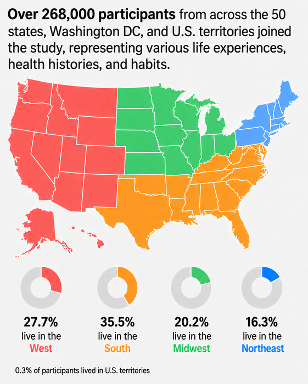
The Apple Hearing Study launched in 2019 as a collaboration between the University of Michigan School of Public Health and Apple, with the World Health Organization (WHO) as a data analysis collaborator. The study enrolled over 268,000 adult participants across the United States who provided their informed consent, with a primary aim to advance the understanding of how health, hearing related behaviors, and sound exposure can contribute to hearing and aspects of health related to hearing.
Over the past seven years, participants shared their hearing health related information and completed study tasks that enabled researchers to both advance their understanding of hearing health and contribute to innovations in Apple products and features such as built in hearing tests and over the counter hearing aids. This study is the largest of its kind to ever assess personal exposures to environmental sound and headphone audio.
While the study will stop collection of new data from participants in October 2026, researchers will continue to use the data collected in this Study for the purposes outlined in the informed consent form to further advance our understanding of hearing health discovery and product innovation.
“At Apple, we believe technology has the power to transform scientific research in areas of health that have been long understudied. By bringing together the expertise of the University of Michigan, the World Health Organization, and Apple, we were able to shed light on hearing health by capturing important insights at an incredible scale. Hearing health plays such a vital role in our overall wellbeing, and insights from this research have shaped the launch of powerful tools like the Hearing Test and Hearing Aid features on AirPods Pro, and also contributed to a broader, global understanding of the impact of noise exposure and hearing health overall.”
- Sumbul Desai, MD, Vice President of Health and Fitness at Apple
“The Apple Hearing Study is a great example of what can happen when researchers work closely with world-class industry partners. Through this study we have gained unprecedented insights into exposures to sound and noise across America. This has in turn allowed us to evaluate how those exposures are influencing Americans’ hearing health. Our study has shown that noise is a ubiquitous environmental hazard across the US, and that there are important gaps in hearing healthcare that need to be addressed to improve public health. The features that Apple has developed from the data collected represent an important step towards addressing these gaps. Most importantly, none of this would have been possible without the invaluable contributions of our more than one-quarter million participants.”
- Rick Neitzel, PhD, CIH, FAIHA, University of Michigan Professor of Environmental Health Sciences and Global Public Health
“This study marks an important contribution to WHO’s global program to ‘Make Listening Safe’ which aims to prevent hearing loss associated with long hours of loud listening. The data and insights gained through this study will be used for driving suitable public health messages targeted at those most at risk of hearing damage due to unsafe listening. It is also encouraging to note that the work on hearing health will continue through the expanded Apple Health Study that could provide further learnings relevant for safe listening and good hearing across the life course.”
- Shelly Chadha, MBBS, MD, PhD, Team Lead – Hearing, Vision, and Oral health, Department of Noncommunicable Diseases and Mental Health, World Health Organization
Let’s celebrate the contributions of everyone involved.
Study at a Glance
| Partners |
|
| Data analysis collaborator | World Health Organization |
| Participants | 268,000+ consented adults in the US |
|
Data collected |
Environmental noise levels, headphone levels, hearing tests, noise notifications, surveys, activity, vitals, and more |
| Devices used | iPhone, Apple Watch, EarPods, AirPods, and other listening devices/headphones |
| Key product outcomes | Informed Hearing Test, Hearing Aid, and Hearing Protection features |
| Study population |
|
Timeline of Key Findings
October 2020 — Millions of Hours of Sound Exposure
- Over 71 million hours of environmental sound levels were measured as of September 2020.
- Among participants who contributed environmental sound data, the daily 8-hour average exposure was 71.9 A-weighted decibels (dBA) - roughly as loud as a running vacuum cleaner.
- Over 5.7 million hours of headphone listening levels were measured as of September 2020.
- Among participants who contributed headphone listening data, the daily 8-hour average exposure was 61.6 dBA - slightly louder than a normal conversation.
March 2021 — World Hearing Day
- 1 in 10 participants had an average headphone sound exposure exceeding the WHO safe listening recommendation of 80 dBA for 40 hours per week.
- 1 in 4 participants had a daily average environmental sound exposure higher than 70 dBA from traffic, machinery and public transport, exceeding the US Environmental Protection Agency’s (EPA) long-term recommendation for preventing hearing loss from noise.
- 2 in 10 participants attended loud events (noisy workplaces, sporting events, concerts, bars, night clubs, fitness classes, etc) at least monthly. Of these, 6 in 10 never wore hearing protection.
- 1 in 10 participants reported being diagnosed with hearing loss. Of these, 3 in 4 did not use corrective support such as a hearing aid or cochlear implant.
- 1 in 5 participants had hearing levels that meet the WHO definition of a hearing loss.
- 1 in 4 participants reported experiencing tinnitus or ringing in their ears a few times per week or more.
March 2022 — World Hearing Day
- The team published an interactive update with data visualizations and findings covering study demographics, environmental sound exposure, headphone audio levels, and hearing testing and hearing loss data.
- COVID-19 lockdown measures were linked to an approximately 3 dB reduction in average environmental sound levels, corresponding to roughly half the sound energy received by the listeners. Average headphone listening levels dropped by approximately 5 dB during this period.
April 2023 — US Maps of Noise Exposure
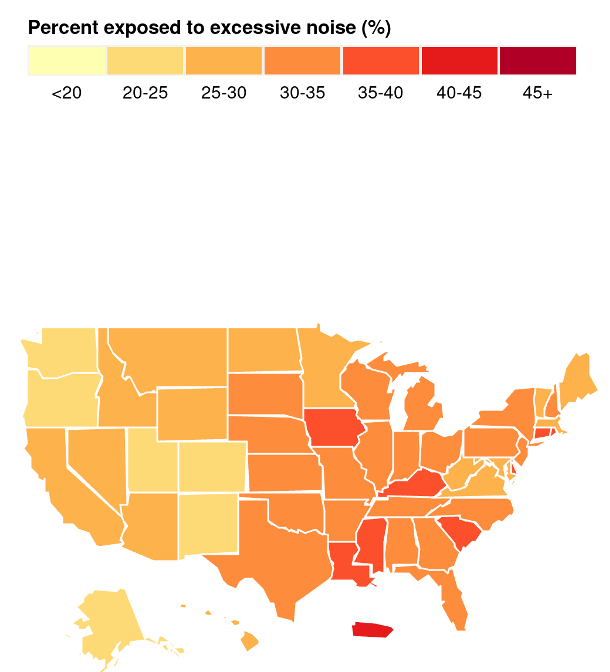
- The WHO and US EPA have identified an annual average noise exposure level of 70 dBA as the level below which the risk of hearing loss is considered negligible.
- An estimated 1 in 3 adult Americans, roughly ~77 million people, were exposed to excessive noise levels above 70 dBA based on Study data from this analysis.
May 2024 — Tinnitus Insights
- Approximately 15% of tinnitus survey participants experienced tinnitus daily.
- Roughly 14% of tinnitus survey participants experienced constant tinnitus.
September 2024 — Apple Hearing Health Features
Hearing loss is the third most common chronic health condition, affecting nearly a quarter of Americans and over 1.5 billion people globally. Data and learnings from the Apple Hearing Study led to the development of three new hearing health features on AirPods Pro 2 and later with AirPods Pro 3:
- Hearing Test — An over-the-counter (OTC) hearing assessment providing an accurate and convenient way to monitor and evaluate hearing levels. Comparable to professionally administered air-conduction audiometric tests. Availability and regulatory status vary by country or region.
- Hearing Aid — An FDA-cleared OTC hearing aid for adults with perceived mild to moderate hearing loss. Uses machine learning for real-time adjustments. Availability and regulatory status vary by country or region.
- Hearing Protection — A feature to help reduce exposure to loud environmental noise by attenuating sounds to lower levels in environments up to 110 dBA.
January 2025 — Super Bowl Noise
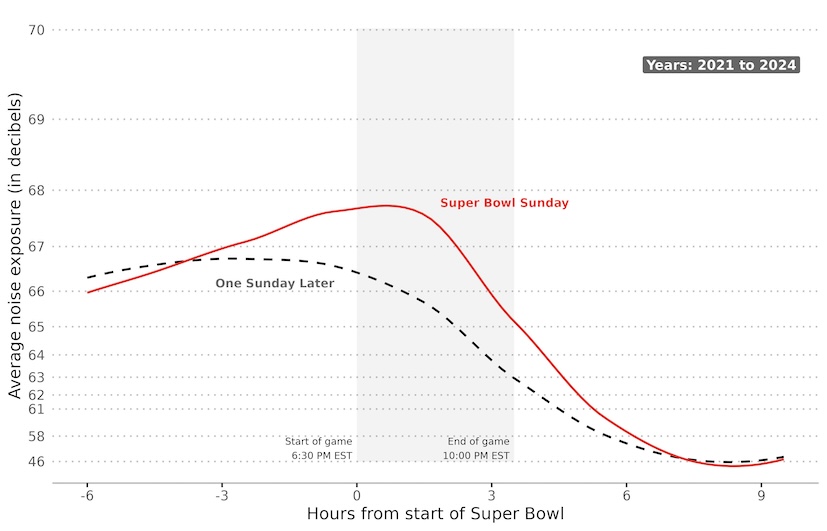
- Analyzed over 115,000 participants with Apple Watch who shared data from the Noise app with the Study before and after the 2021-2024 Super Bowls.
- Found ~1.5 to 3 dB increase in noise levels on Super Bowl Sundays vs. the following Sunday on average across the country. The increase began ~3 hours before kickoff and lasted ~3 hours after the game ended.
| Increase in decibels | Increase in sound energy | Increase in how loud it sounds |
| 3 dB | Twice as much | Barely noticeable |
| 6 dB | Four times as much | Noticeable |
| 10 dB | Ten times as much | Twice as loud |
July 2025 — Tinnitus & Heart Rate Variability
- Analyzed Heart Rate Variability (HRV) data from over 72,000 participants who answered tinnitus questions and wore an Apple Watch.
What is HRV? Heart Rate Variability measures variation in the time interval between heartbeats. Higher HRV can signal a healthier balance between the sympathetic and parasympathetic nervous systems. Lower HRV can signal chronic stress, aging, or reduced fitness.
- HRV was lower when participants reported tinnitus that interfered more with hearing, sounded louder, lasted longer, or occurred more frequently.
April 2026 — Hearing Feature Analysis
- Analyzed data from over 84,000 participants who had self-reported hearing data and values across a four-frequency pure tone audiometric test (4PTA).
- 16% of participants classified as having clinically normal hearing self-rated their hearing ability as fair or poor, illustrating the gap between hearing loss classification and perceived hearing ability.
- Among individuals classified with clinically normal hearing, participants who reported excellent hearing generally had better 4PTA values, and those with generally less than excellent perceived hearing had worse 4PTA values.
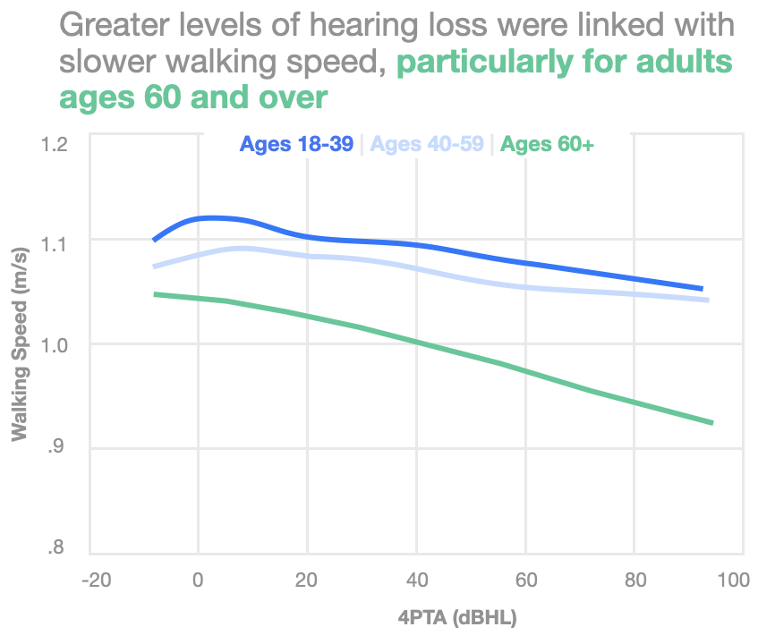
- Analyzed data from over 57,000 participants with 4PTA measures and iPhone walking speed data.
- Greater levels of hearing loss were linked with slower walking speed, shown to be more pronounced with adults 60+.
Hearing Health Recommendations
Apple and the Apple Hearing Study collaborators have put together practical tips to help people protect and support their hearing. The recommendations below cover safe listening practices, hearing protection, and tips to manage tinnitus.
World Health Organization’s Safe Listening Recommendations
If you think you are listening to audio at high volumes, or your Apple devices indicate that you have high headphone sound exposures, here are some tips for reducing your exposure:
- Limit volume to WHO recommended levels (80 dBA for 40 hours a week for adults, 75 dBA for 40 hours a week for children).
- Limit time spent listening at high levels.
- Use well-fitted headphones or noise-cancelling headphones to avoid having to increase volume to overcome background sound.
- Monitor your headphone sound exposure or sound allowance using the features available in the Health app.
- Take listening breaks.
- Move away from loudspeakers or other loud sound sources.
- Use correctly fitted hearing protection at loud events.
- Seek assessment if experiencing persistent tinnitus, muffled hearing or difficulty hearing.
To find out more about safe listening, visit the WHO’s Make Listening Safe website.
What You Can Do to Protect Yourself from Noise
If you think you are experiencing excessive exposures to noise pollution, or your Apple devices indicate that you have high noise exposures, here are some tips for reducing your exposure:
- Move away from noisy areas and take regular “quiet breaks” to let your ears and mind rest.
- When buying new appliances, equipment, or tools, consider buying the quietest possible unit.
- Wear appropriate hearing protection devices when it is noisy.
- If you have an Apple Watch, make it a habit to check your Noise app levels.
- You can also download a smartphone-based sound level meter, such as the NIOSH Sound Level Meter app for iOS.
What You Can Do about Tinnitus
Tinnitus is the perception of sound, such as ringing, buzzing or hissing, without an external sound source. It can have many causes and may be temporary or persistent. While there is no guaranteed method to prevent tinnitus, you can take steps to minimize the risk of developing it by limiting exposure to loud noise. The risks and severity of tinnitus can be reduced by adopting the following practices that aid in maintaining hearing health:
- Consistent use of hearing protection in loud environments
- Avoiding loud environments when possible
- Managing stress levels
People who experience persistent or bothersome tinnitus should seek assessment from a qualified health professional, particularly if the tinnitus is sudden, occurs in one ear only, pulses in time with the heartbeat, or is accompanied by sudden hearing loss, dizziness or other neurological symptoms.
Management depends on the person’s needs and any underlying condition. Approaches may include:
- Education and counselling.
- Cognitive behavioral therapy to reduce tinnitus-related distress.
- Use of hearing aids when hearing loss is present.
- Appropriate sound-enrichment strategies.
- Adopting stress management and healthy sleep practices.
We will share additional insights from the Apple Hearing Study as we continue analyses on the tremendous amount of information participants have contributed. These and past study updates will be posted on the study site.
What's Next – The Apple Health Study
As data collection for the Apple Hearing Study ends, we invite you to join the holistic Apple Health Study. This research initiative will further explore how health signals can potentially predict, monitor, and improve health and well-being. The Apple Health Study covers areas of health such as hearing, hormones, mental health, metabolic, neurological, reproduction, respiratory health, sex and gender, sleep, and more.
You can join the Apple Health Study, if you meet eligibility requirements, by downloading the Apple Research app onto your iPhone and completing the informed consent process.
You can learn more about the Apple Health Study on the Apple Research app.
Thank you for your dedication and commitment over the past seven years. Together, we’ve created a foundation for discoveries in hearing health. Please consider joining as we expand the work to focus more broadly on health in the Apple Health Study. Let’s continue building a healthier future, one insight at a time.