Diving into policymaking for AI in health systems

By Cyrena Matingou
Master’s student in Health Behavior & Health Equity
I’ve always been driven to promote health equity within health-related policies. As a master’s student in Health Behavior & Health Equity at the University of Michigan School of Public Health, I wanted to understand not just what policies should exist, but how they actually came to be. So last fall, as I searched for internship opportunities, I looked for experiences that would take me beyond theory and into the realities of policymaking.
I did not anticipate how hands-on that experience would be. By interning with the Trust, Innovation & Ethics Research for Responsible AI (TIERRA) team this summer, I found myself helping to shape a more equitable future—engaging in cutting-edge public health and health policy projects at the intersection of artificial intelligence and healthcare.
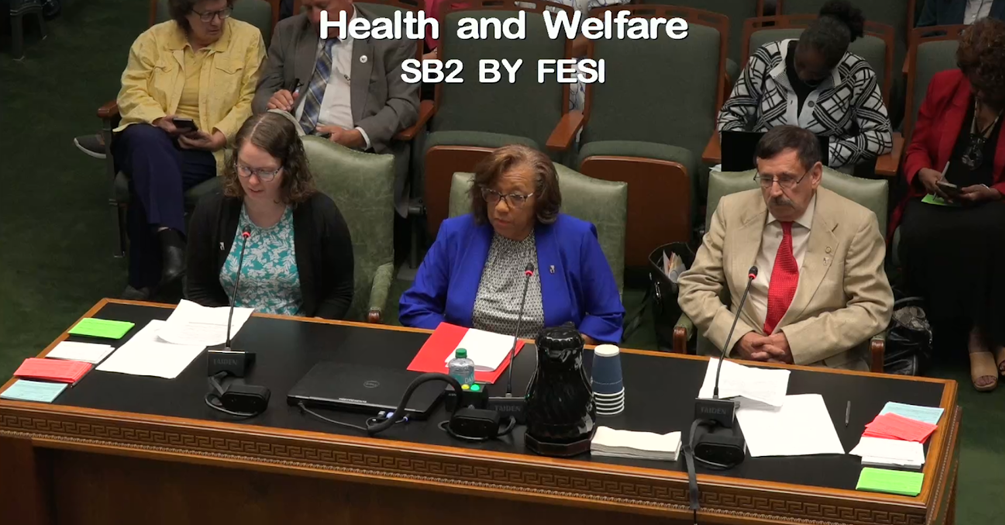
One of my first major experiences came in May when I joined the TIERRA team in Lansing to give a presentation at the Health Information Technology Commission (HITC) meeting. The commission advises the Michigan Department of Health and Human Services (MDHHS) and the Michigan legislature on issues such as enhancing health data utility and addressing Michigan’s digital divide.
At the meeting, Dr. Jodyn Platt presented TIERRA’s work and objectives, focusing on the use of artificial intelligence (AI) in healthcare and the ethical considerations of these applications. I supported the group by taking detailed notes and evaluating the priorities of the Commissioners. This information will guide TIERRA’s collaboration with the Commission and the newly established exploratory AI Task Force, which was designed to consider potential ways the state could respond to AI in healthcare settings.
Attending the HITC meeting gave me a unique perspective of the policymaking process. During the discussion portion of the meeting, I observed how the Commissioners cautiously approached the adoption of AI tools by considering various benefits and risks.
Recognizing the transformative nature of AI, Commissioners discussed innovative advances occurring across the state, such as integrating AI chatbots on government websites and the University of Michigan’s Maizey tool. They acknowledged ed the benefits of AI in healthcare systems, such as assisting physicians in making clinical decisions.
But they were equally focused on the risks and equity concerns. Concerns regarding AI and data privacy were noted by many, with commissioners emphasizing the need to keep patients’ health data separate from other data sources. When Dr. Platt spoke about ensuring rural health systems have the infrastructure to support new AI tools.
Two Commissioners also noted the importance of storytelling and human connection when communicating with the public about AI. These concerns underscored the evolving uncertainty surrounding AI, its implementation within healthcare systems, as well as the need for transparent communication with patients and the public about the benefits and risks of AI.
While my work this summer focused on state-level legislation, federal actions around AI will directly impact Michigan. There is no clear federal legislation around AI use in healthcare. In fact, there is active opposition to regulation. President Trump's America’s AI Action Plan states that the "private sector must be unencumbered by bureaucratic red tape" in order to "maintain global leadership in AI." His recent meetings with leaders from AI-invested tech companies like OpenAI, Google, and Meta strongly suggest there will be continued federal pressure to limit AI regulation.
This underscores the need for states to proactively create protections for patients. Fortunately, Michigan is showing increased interest in this area. A recently introduced House bill would prohibit insurers from delaying, denying, or modifying health insurance claims based solely on AI review.
My summer with TIERRA showed me that policymaking isn't just about drafting legislation—it's about listening, observing, and understanding the real concerns of communities and decision-makers. There are legislators thinking about AI in healthcare, and Michigan's AI Task Force can be a space to turn those thoughts into meaningful protections. Given the state's plans to continue leveraging this technology, the work of ensuring ethical AI use in healthcare has never been more urgent.
About the Author
 Cyrena Matingou is a master’s student in Health Behavior & Health Equity at the University
of Michigan School of Public Health, and is pursuing an additional certificate in
Science, Technology, and Public Policy at the Ford School of Public Policy. Cyrena
is driven by the belief that all people deserve to live in healthy environments and
to have access to health-promoting resources. From public policy to clinical settings,
she is committed to advancing equitable health programs and policies. In her free
time, she likes to DJ and read. Matingou is a recipient of the Caldwell Health Equity Fellowship Fund at Michigan Public Health, named for Cleo Caldwell, professor emerita and former
chair of Health Behavior & Health Equity.
Cyrena Matingou is a master’s student in Health Behavior & Health Equity at the University
of Michigan School of Public Health, and is pursuing an additional certificate in
Science, Technology, and Public Policy at the Ford School of Public Policy. Cyrena
is driven by the belief that all people deserve to live in healthy environments and
to have access to health-promoting resources. From public policy to clinical settings,
she is committed to advancing equitable health programs and policies. In her free
time, she likes to DJ and read. Matingou is a recipient of the Caldwell Health Equity Fellowship Fund at Michigan Public Health, named for Cleo Caldwell, professor emerita and former
chair of Health Behavior & Health Equity.