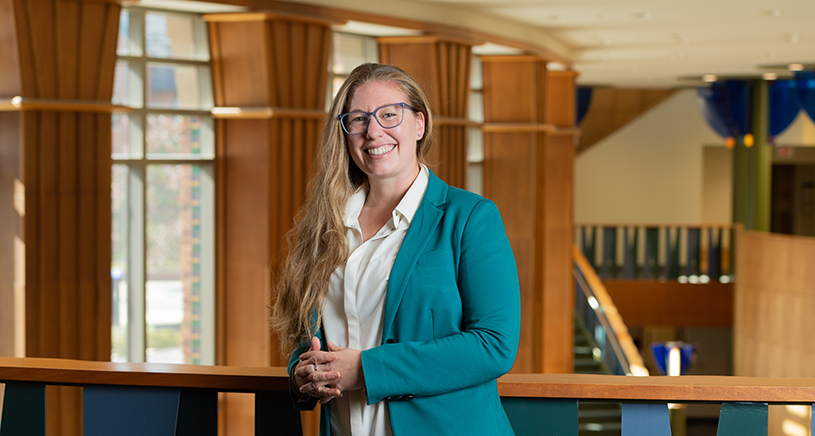
Courses Taught by Kelly Bakulski
EPID512: Biologic Basis Of Disease
- Graduate level
- Residential
- Winter term(s) for residential students;
- 3 credit hour(s) for residential students;
- Instructor(s): Kelly Bakulski (Residential);
- Offered Every Fall
- Last offered Fall 2021
- Prerequisites: None
- Description: This course is taught from an epidemiologic perspective and emphasizes the application of biologic knowledge for public health. Specifically, students will practice skills to develop biology-informed research questions, evaluate physiology-informed approaches to measure health outcomes, and interpret epidemiologic study results in the context of disease pathways.
- Learning Objectives: 1. You will be able to relate the structure and function of organ systems in the human body. 2. You will be able to evaluate biomarker measures of physiologic function, disease, and treatment response for use in epidemiologic studies. 3. You will be able to understand physiologic mechanisms of major diseases to inform research, treatment, and prevention. 4. You will be able to characterize the biologic links between risk factors and major diseases and explain biologic factors that affect a population’s health. 5. You will apply knowledge to develop novel and testable epidemiologic research questions in the context of physiology. 6. You will be able to interpret results from epidemiologic studies in the context of the physiology of that system. 7. You will be able to discuss the science of primary, secondary and tertiary prevention in population health.
- Syllabus for EPID512
EPID604: Applications Of Epidemiology
- Graduate level
- Residential
- Fall, Winter, Spring, Spring-Summer, Summer term(s) for residential students;
- 1-6 credit hour(s) for residential students;
- Instructor(s): Ella August, James Buskiewicz, Sara Adar, Matthew Boulton, Andrew Brouwer, Melissa Beck, Kelly Bakulski, Miatta Buxton, Joseph Eisenberg, Marisa Eisenberg, Nancy Fleischer, Betsy Foxman, Aubree Gordon, Alexis Handal, Jennifer Head, Jihyoun Jeon, Spruha Joshi, Sharon Kardia, Carrie Karvonen-Gutierrez, Lindsay Kobayashi, Peter Larson, Aleda Leis, Elizabeth Levin-Sparenberg, Lynda Lisabeth, Juan Marquez, Emily Martin, Briana Mezuk, Alison Mondul, Lewis Morgenstern, Belinda Needham, Marie O'Neill, Sung Kyun Park, C. Leigh Pearce, Laura Power, Alex Rickard, Jennifer Smith, Eduardo Villamor, Abram Wagner, Xin Wang, Douglas Wiebe, Zhenhua Yang, Jonathan Zelner, (Residential);
- Prerequisites: Instructor Permission
- Description: Application of epidemiological methods and concepts to analysis of data from epidemiological, clinical or laboratory studies. Introduction to independent research and scientific writing under faculty guidance.
- This course is cross-listed with .
- Syllabus for EPID604























EPID639: R For Epidemiologic Research
- Graduate level
- Residential
- Fall term(s) for residential students;
- 2 credit hour(s) for residential students;
- Instructor(s): Kelly Bakulski (Residential);
- Prerequisites: Must be a current EPID graduate student
- Advisory Prerequisites: Must be a current EPID graduate student
- Description: This course will introduce the R statistical programming language, as implemented through Posit software, for epidemiologic data analysis. The overall goal of the course is to provide students with a set of new data analysis tools for Epidemiology using R through Posit.
- Learning Objectives: 1. Understand what R is and why we use Posit 2. Become familiar with Posit Cloud interface 3. Identify file paths for locations of files within an R project 1. Adapt Quarto markdown YAML header code for multiple report types (.pdf, .html, .docx) 2. Render Quarto markdown files (.qmd) to produce reports that contain both code and output 1. Classify R object types (vector types, data frames) 2. Implement functions to perform actions on data objects 3. Use R as a calculator 1. Apply functions to import and export datasets 3. Explore a newly imported data frame 1. Implement best practices for tidy coding and file organization 2. Use the help viewer to assess new functions and function default settings 3. Practice parsing error/warning messages and troubleshooting solutions in code 4. Identifying online resources for solving coding issues 5. Perform logic checks by comparing expected and observed output 1. Select columns in a data frame 2. Order and filter dataset rows based on participant criteria 3. Join multiple data frames into one 1. Create new variables from existing variables 2. Understand how to code and wrangle missing data 1. Understand the required and optional components of a scatterplot with ggplot2 2. Prioritize plot types (bar chart, histogram, boxplot) based on data types (number and shape of covariates) 1. Describe coding features (labels, limits, colors, legends, size, transparency) for common plot types 2. Generate multipaneled plots to view data by groups 3. Export plots from Posit for use in other programs 1. Based on variable type (continuous, categorical) determine appropriate measures and functions for assessing central tendency and spread 2. Describe univariate and bivariate distributions of variables using central tendency and spread 2. Describe univariate and bivariate distributions of variables using central tendency and spread 2. Describe univariate and bivariate distributions of variables using central tendency and spread2. Describe univariate and bivariate distributions of variables using central tendency and spread 1. Calculate univariate and bivariate statistics 2. Create professional and reproducible descriptive statistics tables for export 1. Review selecting statistical methods by variable characteristics. 2. Implement and interpret output from two category tests: Correlation tests, T-tests, Wilcoxon rank sum test. 3. Implement and interpret output from multiple category tests: ANOVA, Chi-square test, Fisher's exact test 4. Generate and interpret odds ratios 1. Construct and interpret simple & multivariable linear models (continuous and categorical predictor variables) 2. Create professional and reproducible regression output tables for export 3. Create plots for regression diagnostics 1. Apply formats for date objects 2. Describe when to use for loops and how they work 3. Develop custom functions to perform repeated tasks 1. Explore generalized regression function options including for splines, logistic regression, Poisson regression 2. Become familiar with code for matched case-control studies, survival analysis 3. Explore coding mixed effects models for clustered data 4. Try adding weights for complex survey samples 5. Perform a meta-analysis in R
- Syllabus for EPID639
EPID698: Ms Capstone In Epidemiology
- Graduate level
- Residential
- Fall, Winter term(s) for residential students;
- 3 credit hour(s) for residential students;
- Instructor(s): Staff, Sara Adar, Ella August, Kelly Bakulski, Melissa Beck, Matthew Boulton, Andrew Brouwer, James Buskiewicz, Miatta Buxton, Carol Chenoweth, Philippa Clarke, Marisa Eisenberg, Joseph Eisenberg, Nancy Fleischer, Betsy Foxman, Aubree Gordon, Alexis Handal, Sioban Harlow, Michael Hayashi, Jennifer Head, William Herman, Kirsten Herold, Tyler James, Jihyoun Jeon, Spruha Joshi, Sharon Kardia, Carrie Karvonen-Gutierrez, Mark Katz, Devon Keen, Lindsay Kobayashi, Peter Larson, Aleda Leis, Paul Lephart, Elizabeth Levin-Sparenberg, Lynda Lisabeth, Juan Marquez, Emily Martin, Dan McConnell, Briana Mezuk, Eve Mokotoff, Alison Mondul, Arnold S Monto, Hal Morgenstern, Lewis Morgenstern, Belinda Needham, Duane Newton, Gilbert Omenn, C. Leigh Pearce, Patricia A Peyser, Laura Power, Meza Rafael, Sarah Reeves, Paul Resnick, Julia Richards, Alex Rickard, Aruna Sarma, Jennifer Smith, Evan Snitkin, Howard Stein, Michael Swain, Eduardo Villamor, Abram Wagner, Xin Wang, Douglas Wiebe, Mark L Wilson, Zhenhua Yang, Jonathan Zelner, (Residential);
- Prerequisites: Enrolled in Epidemiology MS programs
- Description: This capstone research project course is designed for Epidemiology MS students (30-credit or 48-credit CESM programs). Working with their mentor, students are expected to develop an original research project to address public health problems using epidemiologic methods. Students will have the opportunity to apply what they learned in their coursework to important public health questions. Students will work with a faculty mentor to conduct a literature review, develop a research project, develop and implement an analysis plan, write up the results and discuss the implications of the findings, and present their work in the annual Epidemiology Poster Day. Students are expected to begin their capstone project in their first term and complete it in the second term of their final year (or only, for one-year programs) of training (three credits per term, for a total of six credits). The Epidemiology Master’s committee will help students find an appropriate mentor. Details regarding the structure of capstone writing products and evaluation guidelines will be provided in the MS Student Handbook.
- Learning Objectives: The learning objectives of and skills employed in this course are determined by the specific research project. The list below (which is not exhaustive) provides examples of learning objectives for this course: 1. Assess knowledge gaps in the scientific literature; 2. Develop a scientific research question designed to address a gap in the scientific literature 3. Identify appropriate data sources to address a research question; 4. Better understand the role of data in understanding public health problems; 5. Create a data collection instrument and/or collect data; 6. Analyze data (quantitative or mixed data – including both quantitative and qualitative) to test research hypotheses relevant to public health in a manner that reflects principles of epidemiology (e.g., study design, measurement, confounding, etc); 7. Generate appropriate data visualizations and/or presentations; 8. Communicate the significance, approach, and implications of epidemiological research in a written format appropriate for the target audience; 9. Complete research ethics training through the Program for the Education and Evaluation of Responsible Research and Scholarship (PEERRS). Two modules are required: Human Subjects Research Protections and Responsible Conduct of Research and Scholarship (RCRS).
- Syllabus for EPID698