How public health shaped a doctor’s world view
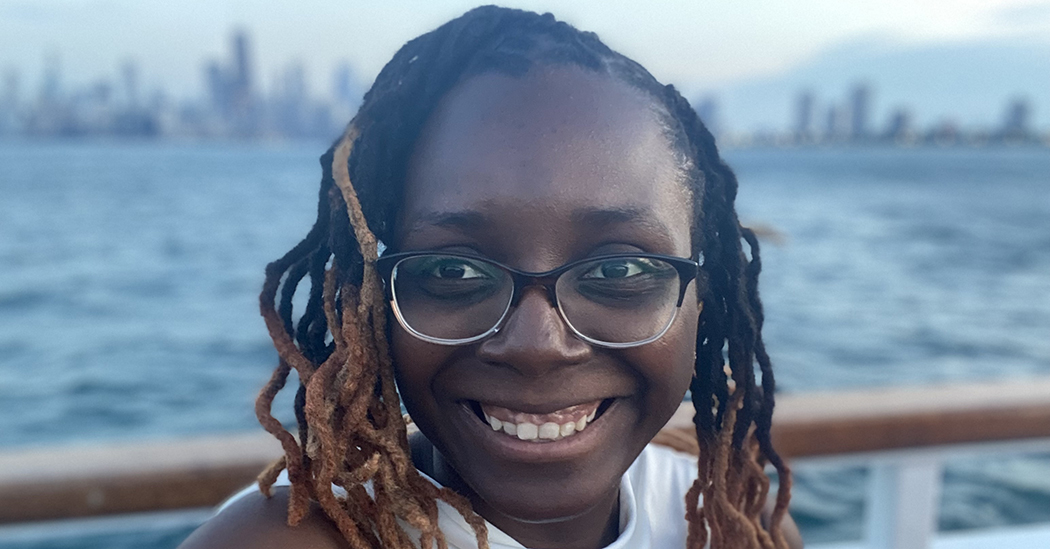
Halimat Olaniyan, BS ’19
Public Health Sciences
By Bob Cunningham
When Halimat Olaniyan, BS ’19, walked into her first obesity course on the pathophysiology of obesity, she wondered how anyone could talk about the topic for three months.
By the end of the semester, she was amazed by how much there was to learn about something society often sees as simple.
That eye-opening experience captures exactly how Olaniyan’s undergraduate years at the University of Michigan School of Public Health transformed her understanding of health and medicine and shaped her career path.
Today, Olaniyan is finishing her residency in pathology at the Indiana University School of Medicine and preparing for a fellowship in transfusion medicine. But her journey started in Atlanta after her family won the visa lottery and moved from Nigeria when she was 4. Three years later, she and her family then moved to Sterling Heights, Michigan, where she was was diagnosed with sickle cell at 7, changing her life and setting her on a journey to medicine.
It was so interesting, combining economics, housing infrastructure, food inequalities and social justice in really unexpected ways that I don’t think any other field of study combines.”
Finding her voice through education
As a high school student, Olaniyan knew she wanted to help people, but she didn't have the words to describe what she was passionate about. She cared deeply about unfairness in healthcare, but terms like “health disparities” and “social determinants of health” weren’t part of her vocabulary yet.
“I was really passionate about those things, but I just didn't have the words for it," she said. “Before college, I didn't have the vocabulary that the School of Public Health gave me.”
When Michigan Public Health announced its new undergraduate public health program in 2015, Olaniyan was one of the first students to apply for what would become her Bachelor of Science in Public Health Sciences degree. She had been considering other majors such as anthropology and linguistics, but the new program seemed to combine all her interests perfectly.
“Reading about the different courses that were going to be offered, they sounded so interesting,” she said. “In public health, we talk about ethnographies, which stem from anthropology, so it’s studying people and their cultures, but how those tie back to the evolution of disease.”
Being part of the first undergraduate cohort at Michigan Public Health came with special benefits. The small group of just over 100 students created tight bonds that continue today.
“Getting to know all of them individually—still being close with a good majority of them—that was amazing,” Olaniyan said. “I didn’t think you could get that at Michigan because the university is massive. So, getting to have the best of both worlds was really enticing.”
The intimate class sizes were a stark contrast to typical university courses. At the time, some public health classes had only 12 students, creating opportunities for deep discussions and personal connections with professors.
But the real magic happened in how the program connected different fields of study.
Olaniyan recalls a course called “Social History of Infectious Diseases,” taught by Jon Zelner, associate professor of Epidemiology, that traced the history of illness across the country by looking at housing, fire department locations, and where communities placed their water treatment facilities.
“It was so interesting, combining economics, housing infrastructure, food inequalities and social justice in really unexpected ways that I don’t think any other field of study combines,” she said.
Overcoming challenges with support
Like many high-achieving students at Michigan, Olaniyan faced her first real academic challenges in college. She had to learn how to separate her self-worth from her grades and find new ways to study and succeed.
“Things like organic chemistry were terrifying,” she said. “I think a lot of my self-worth was intertwined with my academic success but learning how to separate that out and appreciate the curve was important.”
Olaniyan participated in the Summer Enrichment Program in Health Equity and Leadership Training in Healthcare (SEP-HEALTHSpark) and Public Health and Michigan Health Sciences Career Development Academy, which helped her prepare to take the Medical College Admission Test (MCAT) and write her medical school application. Through SEP-HEALTHSpark, she updated the Campus Mind Works website and later earned an internship for Washington, DC-based Path Finder International.
Her public health classmates became her support system. They formed study groups and group chats that helped everyone succeed academically and personally. That support network remains strong today.
Olaniyan also credited the support she received from the university’s disability services that provided crucial help as she dealt with her chronic illness, including transportation to classes on difficult days and access to beautiful private study spaces that helped her focus and succeed.
“Having the support and that comfort, knowing that resources existed at Michigan, helped me reach out for similar support in medical school,” she said.
Building bridges for others
While preparing for medical school, Olaniyan discovered that many of her talented classmates were afraid to apply. They worried their applications weren’t good enough, even though she believed they were just as qualified as she was.
“I remember telling them, ‘I don't know what you’re talking about. I feel like we’re on the same page. Go for it,’” she said.
When Olaniyan got accepted to the University of Cincinnati College of Medicine, she decided to help her friends who were applying the following year. That informal mentoring grew into something bigger, a website that eventually became a nonprofit called Chasing Medicine.
The organization provided free advice about medical school applications and connected students with research and shadowing opportunities. It all started from her experience in the Black Undergraduate Medical Association (BUMA) planning the Future Physicians Summit, which hosted pipeline events that brought middle and high school students from Detroit to campus.
“A lot of these students were like, ‘I’ve never seen a Black doctor before,’” Olaniyan said. “Just heartbreaking, mind-blowing things. That event changed my life and showed me there's a need for this.”
Meanwhile, as Olaniyan progressed through her medical education, she knew she wanted to combine patient care with her public health interests. She found that perfect balance in pathology and transfusion medicine.
“I chose pathology to get to transfusion medicine because pathology on the clinical side is really management and business heavy,” she said. "The transfusion medicine side maintains a lot of that business stuff, but it’s very much about health equity and health justice. Controlling the blood supply is a big responsibility.”
Her path wasn’t always smooth.
Medical school brought new challenges that no one had fully prepared her for.
“Med school is like working a full-time job that you’re paying for the privilege to do and also being a full-time student at the same time,” she said.
But her public health foundation helped her understand why she was pursuing medicine. It wasn’t just about treating sick people; it was about preventing illness and addressing the root causes of health problems.
My view of the world is shaped by public health. And I'm always going to approach my work with that mindset, whether I'm caring for sick people or working to prevent illness in the first place.”
Lasting connections and impact
The relationships Olaniyan built at Michigan Public Health continue to shape her career.
She still maintains close contact with faculty like Melissa Creary, associate professor of Health Management and Policy and Global Public Health, and Sarah Reeves, assistant professor of Epidemiology, who continue to open doors and advocate for her work. They both supported Olaniyan in all her sickle cell-related aspirations, which eventually led to her writing a collection of short stories in her book “Breaking the Cycle of Pain.”
“I’m a strong believer that where you live is the most important detail to determine your overall health,” she said. “I got that from the School of Public Health. It’s come to define what I do in a lot of ways.”
Her nonprofit eventually merged with Color of Medicine, a Chicago-based organization. Meanwhile, a handful of her friends who initially skipped applying to medical school are now enrolled in medical programs themselves.
‘So many different avenues’
As Olaniyan prepares to start her fellowship that focuses on blood supply and transfusion medicine at the University of Illinois Chicago next year, she sees her public health training as the foundation for everything that comes next. Whether she eventually pursues a Master of Public Health degree or focuses on other interests such as writing and public speaking, she knows her approach will always be shaped by what she learned at Michigan.
“Public health is about being adaptable,” she said. “I love that I have so many different avenues I could go. Even in my future job, I will take a public health mindset. How can I improve the blood supply? How can I make this more equitable? How can I give back to the community?”
For Olaniyan, being one of the first undergraduate students at Michigan Public Health wasn’t just about earning a degree. It was about gaining the vocabulary and framework to understand the world's health challenges, and the tools to do something about them.
“My view of the world is shaped by public health,” she reflects. “And I'm always going to approach my work with that mindset, whether I'm caring for sick people or working to prevent illness in the first place.”