Expanding horizons: Finding career success in unexpected public health role
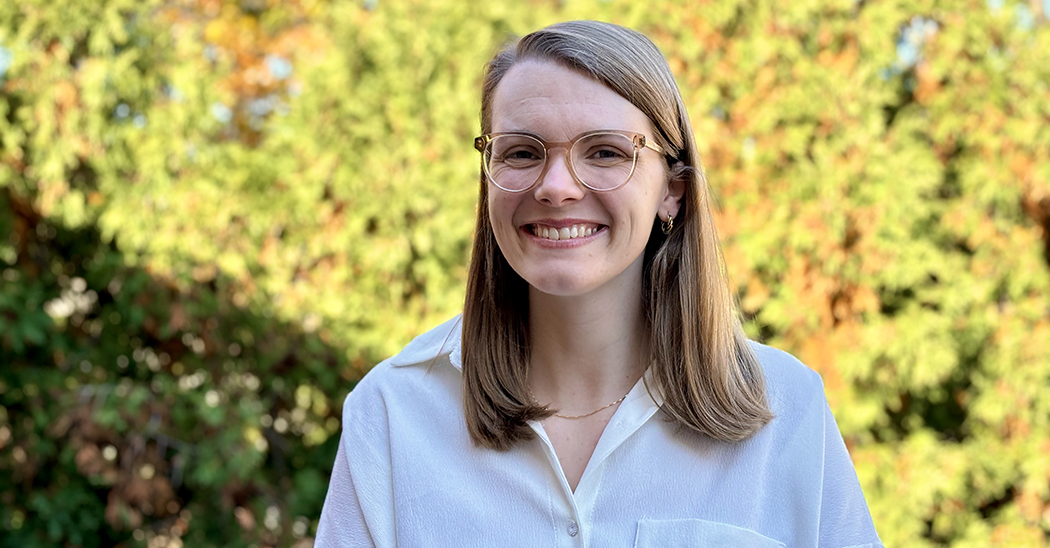
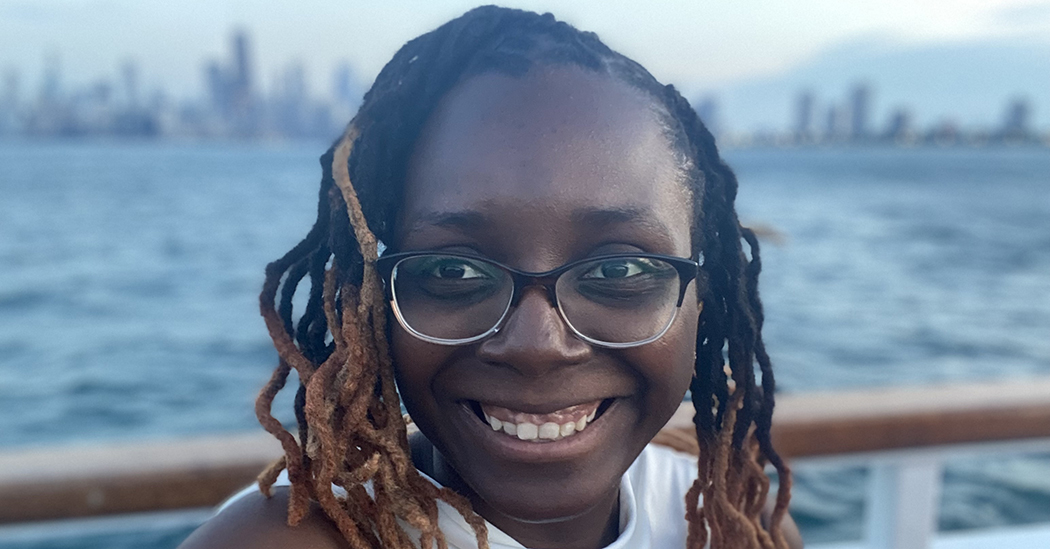
Hannah Rice, MPH ’25
Health Behavior and Health Education
By Bob Cunningham
Hannah Rice, MPH '25, didn't expect to work in managed care when she graduated in May from the University of Michigan School of Public Health with a Master of Public Health in Health Behavior and Health Education with a certificate in Social Epidemiology.
The industry was unfamiliar; the role seemed outside her comfort zone.
Today, working in St. Louis, she helps health insurance plans identify and address health disparities in their systems—and finds the work gratifying in ways she never anticipated.
“I find it to be really satisfying, and I hope I can continue to do that throughout my career,” Rice said.
Getting there required navigating one of the toughest job markets for public health graduates in recent years.
The breadth of her Michigan Public Health education proved essential. Skills from community-based participatory research translated to working with health plans. A health insurance course she took on a whim became the foundation of her daily work. Implementation science training helped her design interventions that work in real-world settings without years of testing.
“I was trained really well at Michigan Public Health,” she said.
PROSPECTIVE STUDENT? Learn more about Michigan Public Health.
A foundation built on service
The seeds of Rice’s public health career were planted long before she understood what the field was. She grew up in Winston-Salem, North Carolina, in a family where service was not optional. Both sets of her grandparents and her parents worked as healthcare professionals, educators or were community leaders
“It was made clear to me from a very young age that one of the things that might bring you joy in this life is using your skills and talents to serve other people,” she said.
Throughout her childhood, Rice encountered her father’s patients in the community. They would tell her how he made them feel cared for and safe. Service was woven into the fabric of daily life.
Despite her healthcare-focused upbringing, the thought of it as a career still hadn’t occurred to her—yet.
“I didn't really understand that public health existed until I was in college,” Rice said. “I thought if you wanted to help keep people healthier, you were a doctor—and I didn't want to be a doctor—so I thought I would be a teacher.”
She earned her undergraduate degree at the University of North Carolina at Chapel Hill, studying Global Studies with a concentration in international politics in Latin America, and entrepreneurship. During the summer after her freshman year, an internship at a hospital system introduced her to population health concepts.
Somebody explaining to me how factors beyond medical care—like housing, income, education and neighborhood conditions—shape a person's ability to stay healthy was just such a lightbulb moment for me.”
The real turning point came during a college course on global health when a professor described social determinants of health.
“Somebody explaining to me how factors beyond medical care—like housing, income, education and neighborhood conditions—shape a person's ability to stay healthy was just such a lightbulb moment for me,” Rice said.
The concept resonated deeply. She had grown up visiting food pantries with local youth groups and discussing housing needs in her community. However, no one had explicitly connected those activities to health outcomes.
“Where you live, where you play, the family you’re born into, the street you live on, your proximity to the grocery store—these are all things that have a big influence on your health,” Rice said.
She realized she could contribute to improving health without becoming a physician.
READ MORE about faculty, students, alumni and staff.
Finding her public health home
After graduating from North Carolina in 2020, Rice had planned to one day attend law school. She had secured a position at a small law firm in Boston, but the pandemic eliminated that opportunity.
Instead, she found work as a research assistant studying fall prevention at a Boston hospital. The position introduced her to public health research and changed her career plans. That unexpected detour became the first lesson in flexibility that would serve her well years later.
Rice chose the Health Behavior and Health Education program (now named Health Behavior & Health Equity) at Michigan Public Health for its commitment to community-engaged work.
“Health Behavior and Health Education really picks apart what makes something that’s community-engaged successful,” Rice said. “How do you actually get in the field and do that?”
She studied under prominent faculty including Barbara Israel and Amy Schulz, both well-known figures in community-based participatory research. She also found unexpected mentors.
Bill Lopez guided her through an independent study examining how art could disseminate information about the public health harms of immigration raids while Brian Zikmund-Fisher taught her to think critically about healthcare communication.
Rice also became interested in implementation science, which focuses on designing health interventions that work when deployed in real-world settings. The field addresses a significant problem: On average, it takes 17 years for health research to be implemented in ways that serve patients.
One class particularly shaped her career trajectory. After meeting Marianne Udow-Phillips, a lecturer from the Department of Health Management and Policy and a member of the Dean’s Advisory Board, at a luncheon with the dean, Rice enrolled in a health insurance course during her final semester. Udow-Phillips encouraged her to take it.
“I think you need this; I think you need to know this—this is something that everybody should understand,” Rice recalled Udow-Phillips telling her. “I now use what I learned in this class every day of my job.
“She’s still a mentor now—I keep up with her regularly—and a huge supporter. She is someone who is always: You can do more than you think you can do.”
The course taught her to navigate the complex US healthcare system and build business cases for health equity initiatives.
“It taught me to think super pragmatically about how to go out there and build the business case for why promoting health equity works out,” Rice said.
Udow-Phillips said Rice was an ideal student.
“Hannah was one of those students that every faculty member longs to have in their class: She wanted to understand everything,” Udow-Phillips said. “She came in with an open mind and was hungry for knowledge. She was eager to participate in all class discussions and to get out of her comfort zone.
“I am so delighted she is now able to put to use all that she learned at Michigan Public Health throughout her life. I know she is deeply committed to meaningful work that will make such a difference to so many.”
Rice also completed a summer internship with CAPHE (Community Action to Promote Healthy Environments) in southwest Detroit, working with Schulz.
“That was my first time getting to sit down at the table as a researcher and be like, OK, I am here not to lead; I am 100% here to support and live out the vision of what this community wants for their community,” Rice said.
She also was supported by the Chang Internship and Scott K. Simonds Scholarship funds as part of her Life-Changing Education at Michigan Public Health.
SUPPORT research and engaged learning at Michigan Public Health.
Adapting to a challenging job market
After graduating from Michigan in May, Rice faced a difficult job market. The search required extensive networking and openness to possibilities she had not considered.
“Anybody in St. Louis who was touching public health, I was on LinkedIn trying to talk to them,” she said. “Just having tons of conversations with people really helped open my eyes to new opportunities.”
Every class I took changed my mind about something in the best way. That’s part of why I wanted to get this degree from Michigan Public Health, to sit in a room of people that are different from me and have them help me change my mind and see things differently.”
Rice had to overcome her own assumptions about what jobs she was qualified to do. At first glance, managed care did not seem like the right fit. However, conversations with people working in different areas of public health helped her see connections between her training and unexpected career paths.
“I might have not applied for this job because I didn’t think I could do this type of work,” Rice said.
In her current role, Rice helps health plans identify disparities in their systems and improve healthcare quality for underserved populations. The work draws on multiple aspects of her Michigan Public Health education. She uses research skills to analyze data, applies implementation science principles to design solutions, and draws on her health insurance knowledge to navigate the complex managed care environment.
The work happens in real time without years of testing or extensive research funding.
“We don't have years to test them out; we don't have all this research funding to make sure they work,” Rice said. “It’s just very much here's this problem; what's something that we can do to fix it?”
SUPPORT health and well-being.
Expanding horizons in public health
Rice hopes her career will ultimately give more people more choices about their health.
“I don’t necessarily believe in prescribing one idea of what it means to be healthy,” she said. “But I think it would really be meaningful for me to know that whatever work I end up doing long-term in this field is work that gives more people more choices.”
Rice encourages current students to get to know faculty members and understand their motivation—their why—for working in public health. She also emphasizes the value of taking classes outside one’s comfort zone.
“Every class I took changed my mind about something in the best way,” she said. “That’s part of why I wanted to get this degree from Michigan Public Health, to sit in a room of people that are different from me and have them help me change my mind and see things differently.”
Her advice to job seekers reflects her own experience: Remain open to unexpected opportunities and trust in the breadth of public health training.
“The work is out there,” Rice said. “You just have to really dig in to find it.”
For a healthier future in a changing world, LOOK TO MICHIGAN.