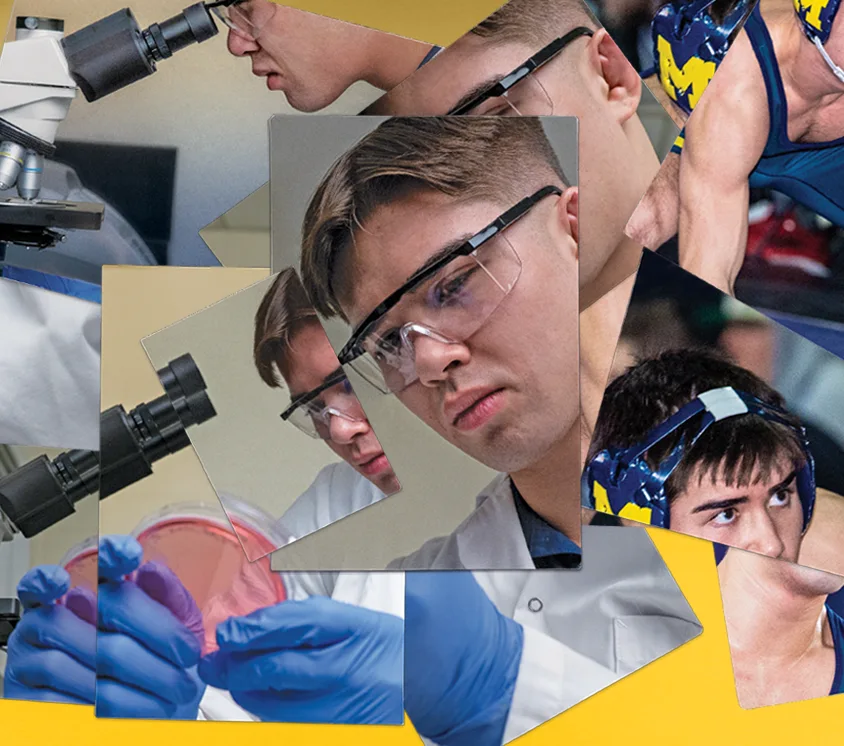

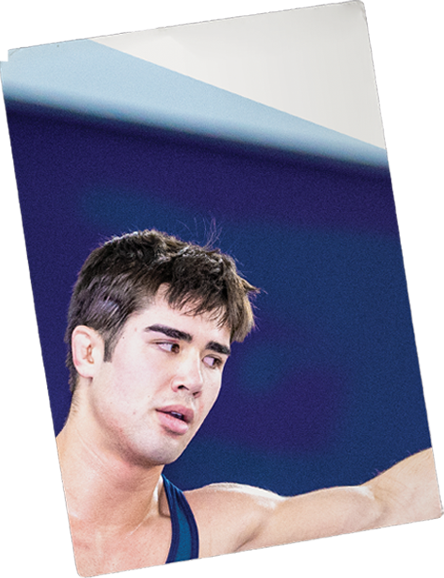
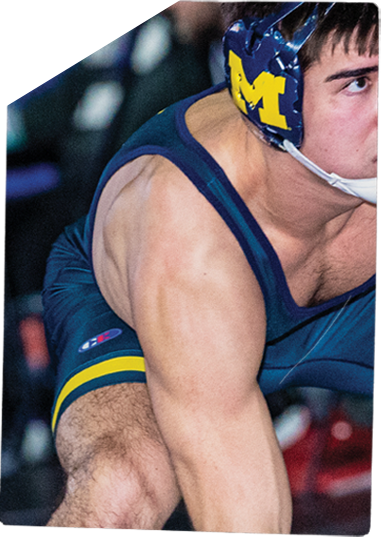
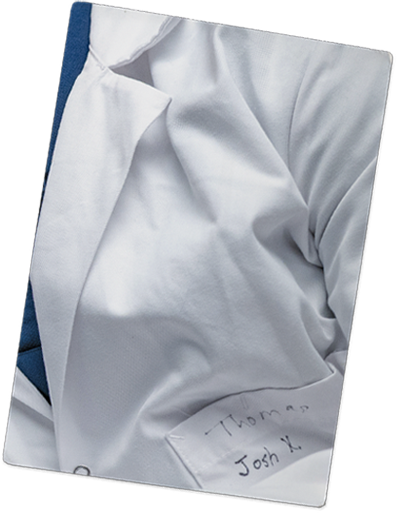
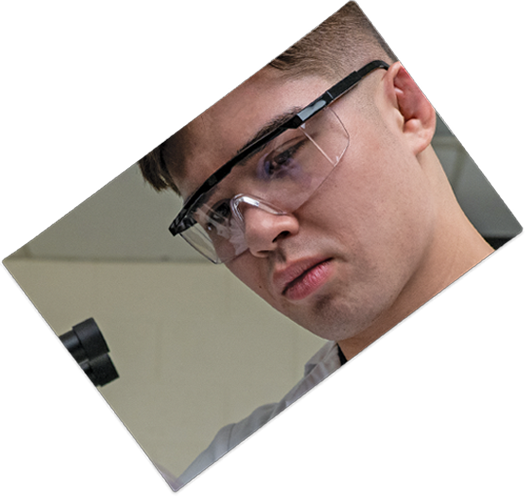
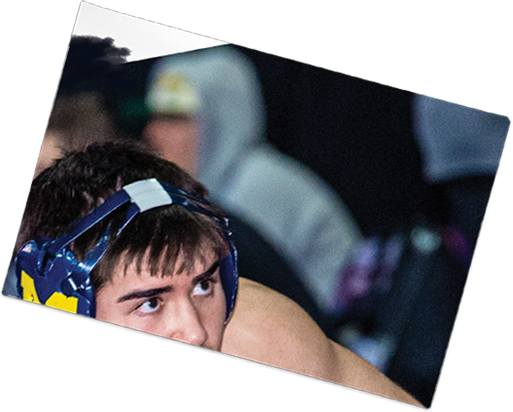
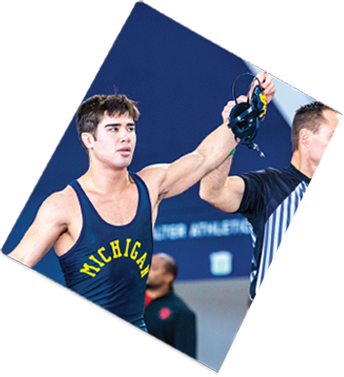
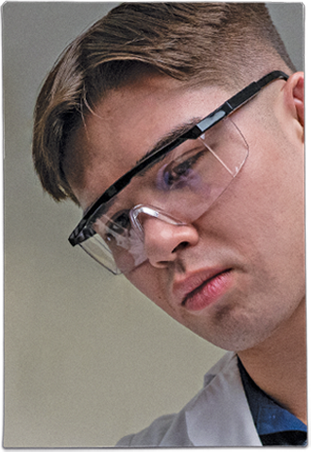
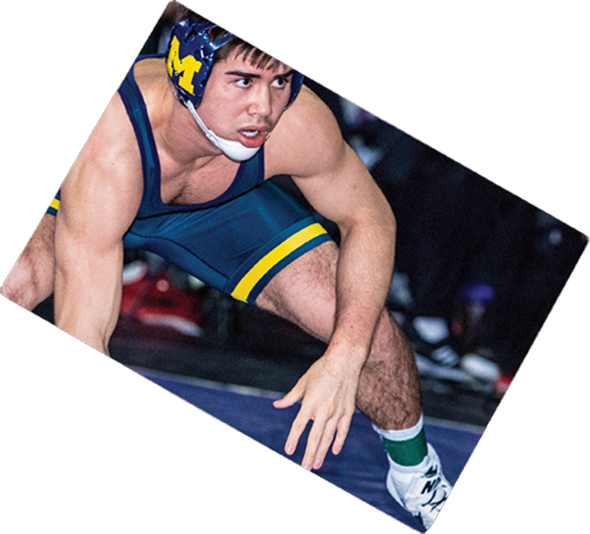
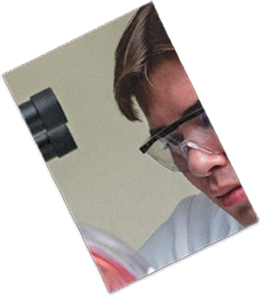
When you meet a Div. 1 Big Ten athlete, you might assume their sport has been their primary driver from a very young age. But for Josh Knudten, a first-year master’s student in Hospital Molecular Epidemiology and a member of the University of Michigan wrestling team, his first love was science.
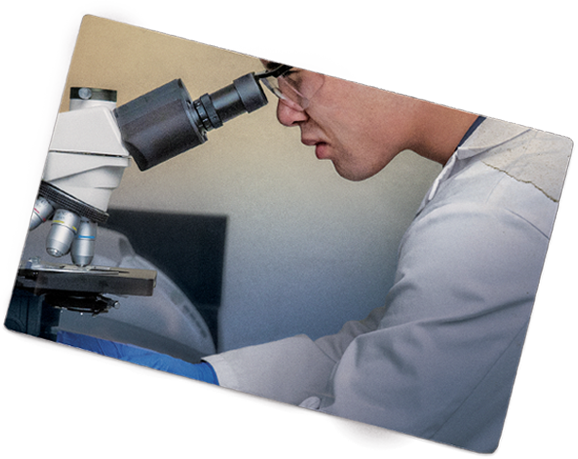
Growing up in Libertyville, Illinois, in a household where both parents, Andrew and Jen Knudten, worked in laboratories—his father still works in biotech—Knudten’s earliest memories involve peering through a microscope at preset slides, marveling at the invisible world suddenly made bigger than life. He’d make his own slides, too, captivated by what he could discover.
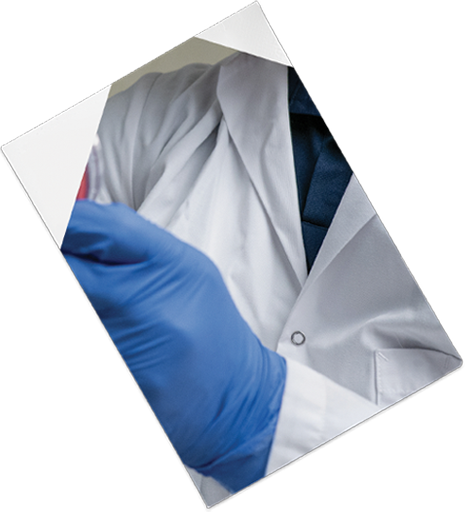
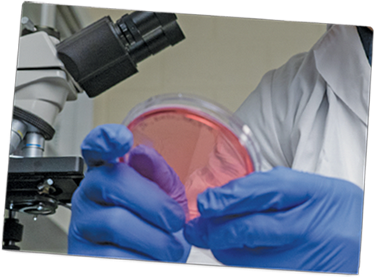
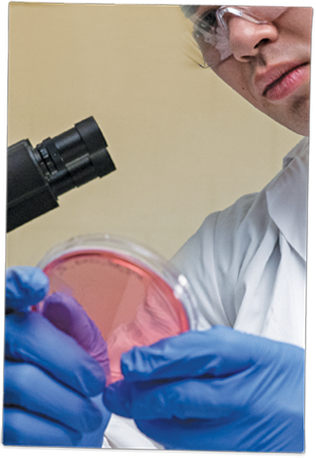
“Using a microscope for the first time was fascinating, and it still is,” Knudten said. “In my Hospital Molecular Epidemiology lab, I love examining bacterial slides, checking out gram stains and the different bacterial forms.”
That childhood fascination has remained constant.
Wrestling? That came later, and almost by accident.
His wrestling career began almost by chance when a friend introduced him to the sport in sixth grade, but Knudten was the only one who stuck with it.
“The funny thing is, he never ended up wrestling, but I fell in love with the sport,” he said.
It was an unlikely beginning for someone who would eventually become a state champion. For most college wrestlers, sixth grade is late to start—many begin the sport in elementary school. But Knudten, who initially thought he’d play football his whole life, discovered something in wrestling that resonated deeply.
After his freshman year of high school, during which he juggled football, wrestling and lacrosse, Knudten made a decisive choice: He quit the other sports and committed himself fully to wrestling, training year-round.
“Through a lot of effort, I caught up to a lot of the guys,” he said.
Working intensively with his high school coach, Zac Brunson, Knudten developed into an elite wrestler, ultimately winning an Illinois state championship his senior year and earning All-State honors in academics as well.
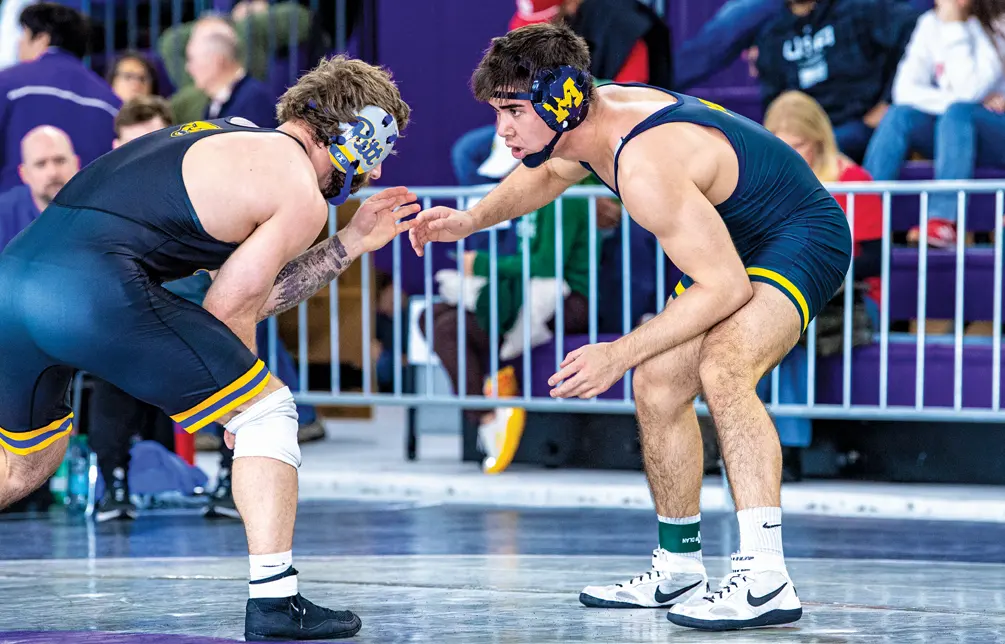
The Michigan equation
When it came time to choose a university, Knudten found himself in the enviable position of excelling in two demanding areas. He hadn’t really considered wrestling in college until his junior year of high school.
“I didn’t seriously consider college or wrestling collegiately until halfway through my junior year, when I realized I could compete at that level,” he said. “When Michigan came up, it offered the perfect combination: elite athletics and elite academics. That’s exactly what I wanted—what I’d been pursuing my entire life.”
At Michigan, Knudten didn’t slow down. He completed his bachelor’s degree in Microbiology in three years while competing for the Wolverines, then transitioned seamlessly into the School of Public Health’s highly ranked Epidemiology master’s program all while maintaining his athletic eligibility.
“I’ve never met a graduate student in the School of Public Health who is also an athlete,” said Knudten, acknowledging his unique position.
Michigan wrestling coach Sean Bormet has watched Knudten navigate this challenging dual path with admiration.
“Josh understands that balance takes work,” Bormet said. “His commitment to both training and academics reflects a level of discipline and accountability that defines him as a student-athlete and made it possible for him to graduate in three years and move directly into a highly demanding epidemiology program in public health.”
Knudten won his high school wrestling team’s mental toughness award, a recognition that speaks to more than just physical endurance. That mental resilience, he said, translates directly to his academic pursuits.
“If I can endure a tough workout where I’m just dying on the ground, I can write an essay,” he said. “And it goes both ways—if I can crank through a 10- to 15-page paper, I can handle a two-hour workout.”
During one particularly demanding semester, Knudten took 18 credits—the maximum allowed—while maintaining his wrestling schedule.
“Michigan throws a lot at you all at once,” he said. “But it’s about staying the course and trusting what I know. I’ve done tough things on the wrestling mat; I’ve done tough things academically to get here. I know I can handle both simultaneously.”
That confidence, he said, comes from never feeling forced to choose between his passions. His parents supported both interests, driving him to practice while keeping him on task with schoolwork. At Michigan, coaches have been flexible with his schedule when classes conflict with practice times, and professors accommodate his competition travel.
“I’ve never really felt the pressure where I had to pick wrestling or pick school,” Knudten said. “Whenever you do anything without pressure, it helps you excel in any area of your life.”

A day in the life
Still, balancing both worlds requires meticulous time management.
A typical packed day for Knudten starts with an early morning lift, followed by classes, then a rescheduled wrestling practice, necessary because some of his required Epidemiology classes overlap with team practice times.
Teammates Dylan Gilcher, Justin Gates and Connor Owens, who Knudten calls “some of my best friends,” adjust their own schedules to train with him during these makeup sessions with assistant coach Jack Medley providing instruction.
After practice comes more classes, then tutoring sessions provided through Michigan Athletics, followed by time in his academic counselor’s office working on assignments. He typically doesn’t get home until 9 p.m.
“It’s 7 in the morning until 9 at night almost every day,” he said. “It’s a lot, but I wouldn’t have it any other way because I love where I’m at, and I love the people around me.”
Those people include Julie Fielding, director of the Graham Family Athletics Career Center, who has helped with resumé building and internship applications; Brian Townsend, director of Michigan Leadership Development, who works with student-athletes’ leadership skills; and Jennifer Head, the John G. Searle Assistant Professor of Epidemiology in the School of Public Health, who has helped Knudten map out his path toward earning both his master’s in Hospital Molecular Epidemiology and a certificate in Public Health Genetics.
“Josh is a highly motivated master’s student,” Head said. “Despite having a full wrestling schedule, he is engaged in his cohort and actively pursuing opportunities to hone his skills in gene therapy and drug development.”
“I’m really blessed that I have so many people who can really help me see the bigger picture and lend me their experience,” Knudten said.

The difference you can make in people’s lives is incredible.

The pivot to population health
Knudten’s path to epidemiology crystallized during an undergraduate microbiology lecture with Marcus Ammerlaan, Hiroshi Ikuma Collegiate Lecturer. Originally planning to pursue medical school, Knudten was intrigued when his professor discussed an alternative path.
“He said most students go into pre-med, but epidemiology was another fulfilling path,” Knudten said. “I didn’t want to be in school that long. I wanted to get to work, and I knew I’d already be here for five years for wrestling.”
The idea of impacting populations rather than individual patients appealed to Knudten’s desire to help people at scale. Combined with Michigan’s School of Public Health—ranked fourth in the nation by U.S. News & World Report—the decision felt natural.
“About half my cohort is microbiology undergrads from Michigan,” he said. “Epidemiology is perfectly aligned with my interests. I want to be a figure in public health and help a lot of people in my future career.”
Knudten’s career aspirations are specific: He wants to work in gene therapy and drug development—ideally in biotech or biopharma—though he’s also considering roles with governmental agencies like the FDA.
His inspiration is deeply personal. His father was involved with Zolgensma, one of the first gene therapies approved for treating spinal muscular atrophy. Knudten has seen photographs of the first families to receive the treatment and watched video interviews of how the therapy changed their lives.
“I saw the effect it had on those families,” he said. “The difference you can make in people’s lives is incredible. If I can impact just one family, that would be so meaningful to me.”
What excites Knudten most about gene therapy is its potential to address the root cause of diseases rather than just managing symptoms.
“There are so many therapies out there that kind of just address the effects—and that’s great—but you need to constantly address the effects,” he said. “Whereas in a gene therapy, you can administer it and the patient will be saved for life.”
Knudten believes the field is approaching a transformative moment.
“We’re almost at a tipping point in genetics, where we can almost do anything,” he said. “I’d be very blessed to be part of that renaissance in genetics.”
With one year of athletic eligibility remaining, Knudten still has unfinished business on the wrestling mat. His goals are clear: qualify for the NCAA Championships, become an All-American, and help Michigan win a team title.
“My plans haven’t changed,” he said. “I’m happy with what I’ve done so far, but it’s not finished yet.”
Advice for the next generation
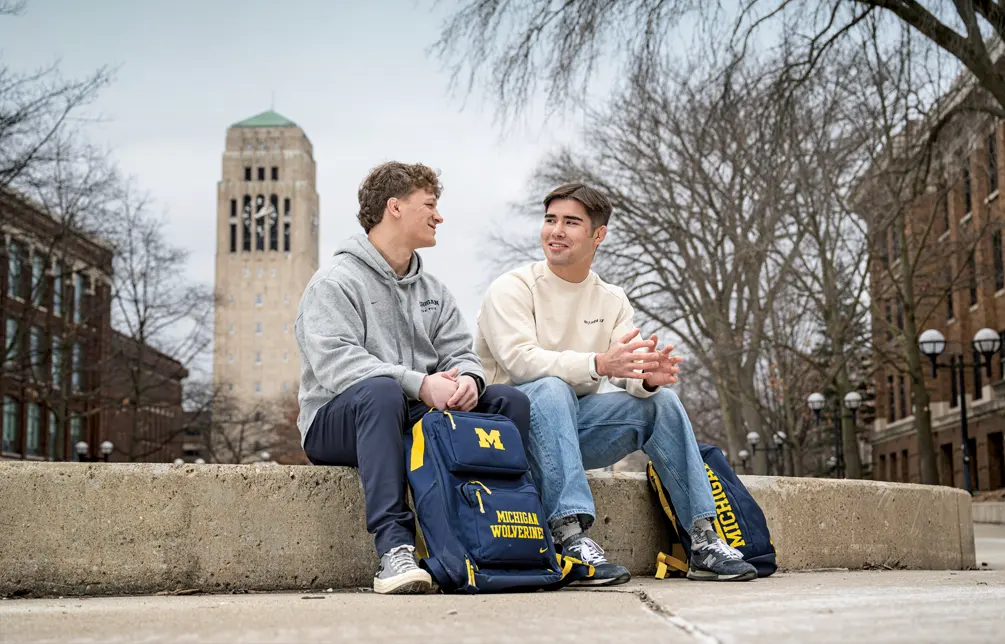
For other student-athletes considering a similar path—particularly in STEM fields that remain male-underrepresented in public health—Knudten emphasizes the importance of using available resources and seeking advice.
“I talked to a lot of people before making any decisions, learning from their experiences and what they’d suggest,” he said. “Use your resources, talk to people, learn from their experience, then make the right decision for you.”
He’s also realistic about the challenges.
“It’s going to be tough with school and all your extracurricular activities, but if you just stay the course, then you’ll get through basically anything,” Knudten said.
Ultimately, Knudten credits athletics with shaping who he is—both on the mat and in the classroom.
“Athletics has been huge for my development and who I am as a person,” he said. “I wouldn’t trade it for anything. I wouldn’t be in this position—academically or athletically—without what wrestling has taught me.”