














Melissa Creary was 3 years old when she received her diagnosis. In 1978, Pennsylvania didn’t yet have universal newborn screening for sickle cell disease, so the genetic blood disorder that would shape every aspect of her life had gone undetected.
That delayed diagnosis—a consequence of policy gaps in public health infrastructure—became one of many threads connecting her personal experience to the work she would eventually dedicate her life to.
Today, as an associate professor of Health Management and Policy and Global Public Health at the University of Michigan School of Public Health, Creary has spent over 20 years working with the sickle cell community as a scientist, policymaker and researcher. But it’s her lived experience as a Black woman navigating the healthcare system with sickle cell disease that gives her scholarship its distinctive power and makes her an unflinching advocate for communities that science and medicine have historically marginalized.
“Obviously, the earliest exposure to public health and science was my own diagnosis,” Creary said. “A reflection of how I was managed from an early age until even deciding that I wanted to go on a scientific path.”
Seeing herself in a textbook
Creary’s first formal introduction to sickle cell disease came from an AP Biology classroom in high school. There, in a textbook, she encountered the genetic diagram of her own condition.
“That was my first understanding of how important sickle cell was to the broader scientific community,” she said. “But I understood it on a whole different level because I was living with it.”
Seeing herself represented in that textbook sparked an early understanding that different perspectives on the same phenomenon needed to be valued. Though she didn’t yet have the language to articulate it, that moment planted the seed for her life’s work at the intersection of science and society.
“Seeing a representation of the genetics of my disease really spurred me on to want to learn more from the scientific realm,” Creary said.
That curiosity led her to pursue a biology degree and work in a molecular biology lab, with plans to earn a PhD in basic science. But something shifted during her time pipetting cells and running experiments.
“I realized that I was more interested in the person than the cells,” Creary said. “I was really interested in getting a basic science PhD when I graduated from college, and then that turned quickly to wanting to get an MPH.”
At Emory University’s Rollins School of Public Health, she found her intellectual home in Behavioral Sciences and Health Education. The program opened her eyes to social determinants of health, community needs assessment and—crucially—how to understand root causes rather than just individual outcomes.
“Those exposures allowed me to better understand the impact of race and racism and its intersection on sickle cell disease, which is primarily known as a Black disease,” she said.
Sickle cell disease is a genetic blood disorder affecting hemoglobin that damages and deforms red blood cells, causing severe pain, organ damage and shortened life expectancy. While it affects people across racial and ethnic backgrounds, it disproportionately impacts the African diaspora, including Black Americans, and the healthcare system’s response has been profoundly shaped by racism.
With her master’s degree in hand, Creary joined the Centers for Disease Control and Prevention’s Division of Blood Disorders, where she would spend nearly nine years co-building what would become her proudest public health achievement: the agency’s first comprehensive sickle cell surveillance system.
“My supervisor, Althea Grant, allowed me to make mistakes, but more importantly, allowed me to use my power as a young person with passion around sickle cell to help build something,” she said.
What started as a small divisional initiative grew into a CDC-wide priority and, eventually, a Department of Health and Human Services priority. Along the way, Creary helped secure millions of dollars in cooperative agreements with the National Institutes of Health.
“We did a really good job of trying to connect data, understanding data for action and how that leads to policy change, while understanding that community still had to be at the center of that voice of change,” she said.
But the experience also taught her hard lessons about government work. Her supervisor encouraged her to pursue a PhD to take the program—and her career—to new heights. The decision meant leaving the CDC temporarily to collect dissertation data in Brazil, studying how race, policy and citizenship intersected in that country’s approach to sickle cell disease.
While she was abroad, political winds shifted back home and budget priorities changed. The team of 12 she had helped build shrank to just two people.
“There wasn’t a lot for me to come back to,” Creary said.
That moment forced a reckoning about what she could accomplish with the freedom to ask harder questions and challenge assumptions. The answer led her to academia—and eventually to Michigan Public Health, where she’s now in her 10th year.
The more marginal the population, the more we have to understand how deep we actually have to go in order to effectively deliver justice.

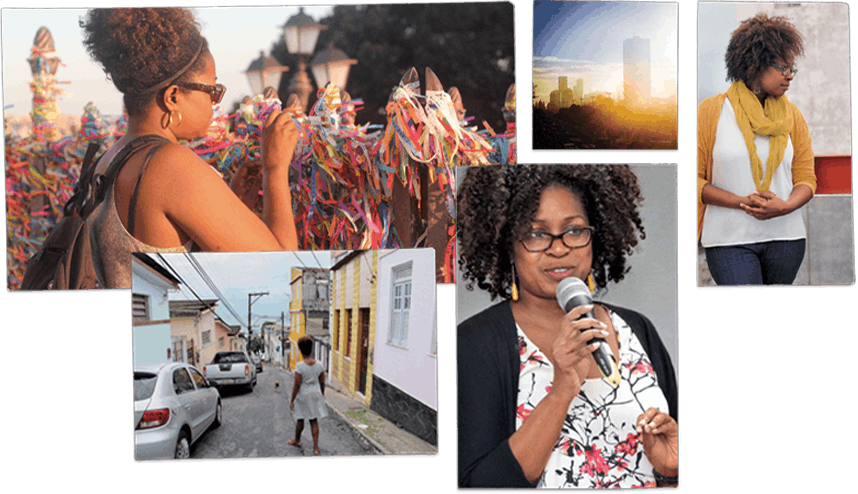
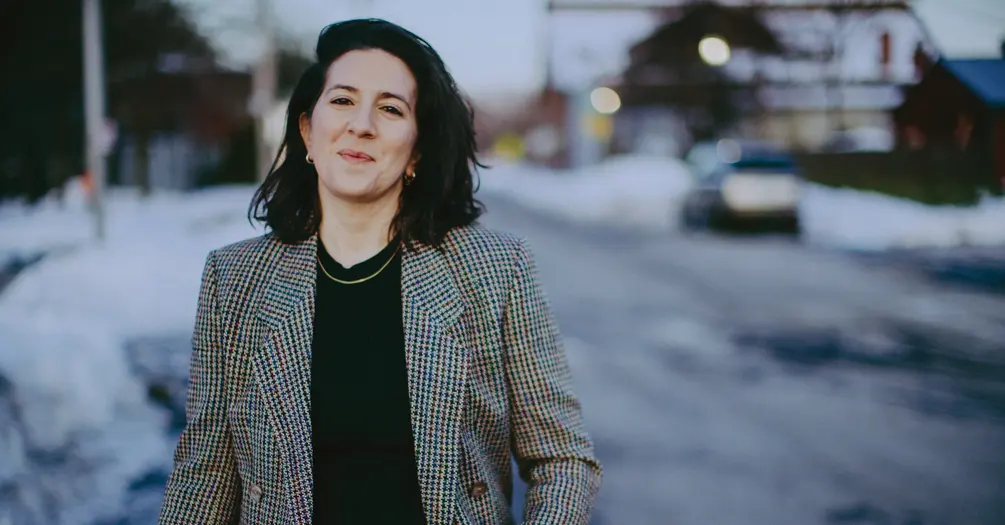
Top: Photos by Dieu-Nalio Chery, Michigan Photography. Above: Melissa Creary in Brazil. (Photos courtesy of Melissa Creary)
The vulnerability of truth-telling
For years, Creary hesitated to publicly connect her personal experience with sickle cell to her scholarly work.
“It’s no one’s business, so it’s a choice that any one of us who has a particular kind of diagnosis gets to make,” she said. “I feared stigma. I feared being thought that I would be a liability. I feared that maybe I wouldn’t be given as much respect in terms of rigor.”
She can trace how she gradually became more emboldened to speak about her own story, and how that vulnerability transformed her impact.
“I can see how the more I was willing to talk about my own story attached to some of the research questions I had, that it made a different kind of impact, and that people wanted to be able to humanize science in particular kinds of ways,” Creary said.
By 2021, when she published her conceptual framework “Bounded Justice,” the feedback confirmed what she’d suspected: Her willingness to center lived experience gave language to something that had been missing.
Creary’s work in Brazil led her to develop two interconnected concepts that now anchor her research: biocultural citizenship and bounded justice.
Biocultural citizenship examines how being a Black Brazilian with sickle cell disease allowed for different ways to access citizenship, and how citizenship was influenced by policymaking for the disease. It’s about understanding how race, place and history are embodied in each person, impacting their relationship to policy.
But bounded justice emerged as her most provocative contribution. Brazil has universal healthcare and laws specifically designed to build equity practices and include affected populations in policymaking. Yet Creary found something troubling: “Even with a law in place to help advocate for equity for certain populations, racism—the weight of racism, the shadow of racism—was still so strong, such that Black Brazilians, particularly with sickle cell disease, felt they still did not have access to the things that they needed.”
Bounded justice names this phenomenon: Even well-meaning interventions and policies intentionally designed to address inequities will fall short when they fail to account for deep structural forces.
“The more marginal the population, the more we have to understand how deep we actually have to go in order to effectively deliver justice,” she said. “Scientific intervention is never enough. We need a full societal intervention that encases that scientific intervention for particular populations in order for justice truly to be understood and felt by the impacted population.”
Correcting the record
At Michigan Public Health, Creary has noticed that students seek her out, often because they’re dealing with their own understanding of exclusion or want to ask questions that challenge accepted norms.
“The folks who end up working with me aren’t necessarily always underrepresented,” she said. “But their research questions might be underrepresented, or the way, methodologically, they want to approach a research question might be underrepresented.”
Perhaps her most important gift to students is teaching them how to be uncomfortable.
“If there’s ever a thing that I’m giving to my students, to my trainees, to my mentees, it’s a deeper way of understanding and being comfortable with how to be uncomfortable,” she said. “How to be in a room to ask uncomfortable questions. How to be the contrarian sometimes. And how to be braver in a world that needs a lot of courageousness.”
There’s a misconception about sickle cell disease that Creary encounters repeatedly: That the population living with the disease isn’t savvy enough to understand what’s at stake scientifically and medically.
“People living with sickle cell are living through a lot of hardship, and at the end of the day, they are still full, rich humans that have so much to offer,” she said. “To think that they don’t understand very clearly what’s at stake for science and public health is a huge misconception.”
This misconception shapes who gets included in scientific decision-making. Creary advocates fiercely for ensuring that people living with sickle cell are part of every piece of the scientific trajectory.
“It’s why I apply for grants that center community in how we structure the research question to begin with,” she said. “It’s why, when I’m asked to consult for pharmaceutical companies, I’m saying: Before you even get to phase one of this clinical trial, you have got to be in conversation with the community to understand the implications of the science.”
Much of her current work examines bounded justice in the context of innovation for sickle cell disease, particularly gene-editing technologies and artificial intelligence in clinical trial design. As conversations proliferate about what sickle cell can offer genomic precision medicine, Creary serves as both champion and critic, celebrating scientific advancement while insisting it cannot be divorced from justice.
The sickle cell community is rightfully wary, she said, “of their bodies being on the line without justice being at the center.”

Resistance as legacy
In this political moment, Creary thinks often about her role as a scientist and educator.
“We feel helpless. What is our role in the unraveling of society right now?” she said. “And I think part of our role can be the ways in which we can help a younger workforce be braver.”
That bravery—the willingness to call things out, to sit with discomfort, to ask hard questions about racism—is deeply tied to being anti-racist.
“Sometimes it feels like it’s never enough, and, honestly, I don’t think it is enough,” Creary said. “But if I can think about my tiny contribution to resistance in this moment—calling things out and allowing for discomfort to happen when it comes to how we talk about, think about, research, call out racisms and all the other isms—and I’m allowed to use my platform as a professor to help other folks do the same thing, there is a legacy there.”
Looking back over her journey—from that delayed diagnosis in 1978, through her work at the CDC, in Brazil and in Ann Arbor—Creary sees the thread of public health woven throughout. The absence of newborn screening. The advocacy her immigrant parents provided. The surveillance systems built to understand population health. The policies meant to ensure equity that still fell short of justice.
“With some critical reflection, it’s all just so public health,” she said.
Her work provides critical analyses of the embodiment of policy via genetic and racial identities—academic language for something deeply personal. Policy doesn’t just affect bodies; it shapes them, determines their possibilities.
For Creary, the personal will always be inseparable from the political and the scientific. Her diagnosis at age 3 was a window into how structural racism operates through seemingly neutral systems.
And her life’s work has been to ensure that other bodies, other lives, other communities receive not just well-intentioned interventions, but actual justice—unbounded, uncompromising and deeply deserved.