Candice Ammori, MS ’20, didn’t follow a traditional path from the University of Michigan School of Public Health’s Biostatistics program to climate entrepreneurship. In fact, she almost didn’t pursue graduate school at all.
After earning her undergraduate degree from Michigan—what she called a “Frankenstein” mix of business, environmental science and policy—Ammori worked in finance in Asia and then in technical sales. But around 2015, she started learning about artificial intelligence and the ethical conundrums surrounding it. She realized that in order to work effectively on complex, data-driven problems, she needed to understand the mathematical foundations.
“If I understood the models, understood the math, I’d be much more effective,” she said. “And I’d also be taken more seriously by people who also understood how it worked.”
That realization led her back to Michigan to pursue a Master of Science in Biostatistics. She spent a year completing prerequisite courses in calculus and computer science before she could even apply, entering the program in 2018.
Then the United Nations Intergovernmental Panel on Climate Change released a sobering report warning that without significant action by 2030, the planet could hit irreversible tipping points—feedback loops where, for example, melting Arctic ice releases more methane, which causes more warming, which melts more ice.
Instead, Ammori decided to pursue climate, seeing an opportunity to apply her growing statistical expertise to the most pressing challenge of her generation. She pivoted her focus while keeping the same analytical toolkit, taking classes in sustainable finance and engineering alongside her core biostatistics curriculum.
“The Biostatistics program being housed within the School of Public Health was really helpful,” she said. “I got to see how the biostats work that we were doing extended beyond the computer into the real world.”
From student to founder
When Ammori graduated during the pandemic in 2020, a job opportunity essentially fell into her lap. A fellow Michigan alum who knew about her interest in climate work was starting a company and asked if she wanted to join. That company was building curated communities for professionals to collaborate across disciplines.
Ammori saw an opportunity to solve a problem she had been experiencing herself.
“I was trying to transition from more of a data science biostatistics background, and I didn’t know where the policy people and the finance people and the lawyers and the engineers and tech people were hanging out together,” she said. “I couldn’t find a space where they were gathering in a meaningful or thoughtful way.”
So she built one.
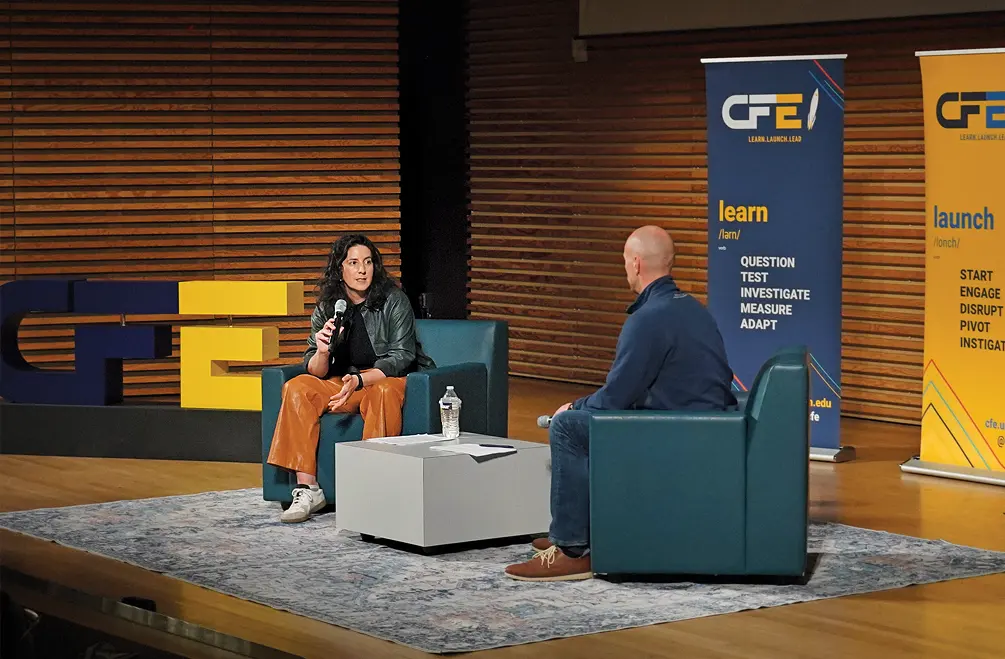
Climate Vine, the organization she founded in 2022 and leads out of New York’s Hudson Valley, connects climate professionals to help them collaborate and accelerate their impact. Members are selected via a competitive application process—Ammori accepts about 14% of applicants—and their backgrounds span policy, investment, corporate, activism, nonprofit, entrepreneurship, and tech and science.
The results speak for themselves. Ammori has brought together more than 1,000 people across the climate ecosystem. Fellows have raised more than $500 million in venture funding, dozens of companies have emerged, and hundreds of contributors have transitioned into the climate innovation space. She maintains deep vertical knowledge as an active investor and advisor to emerging climate tech companies.
But Ammori believes the real value lies in something harder to quantify: the professional relationships that form when experts from different fields tackle shared problems.
“The typical Climate Vine member has 25 more contacts who are professional friends they can call up,” she said. “Those relationships pay the most dividends long-term. Even if they’re not starting a company with someone today, they might do that five years from now.”
The multidisciplinary advantage
Growing up in metro Detroit in the Chaldean community, Ammori was surrounded by small business owners, including her father who owned a convenience store. That entrepreneurial exposure made starting her own company feel less daunting.
But it’s her biostatistics training that gives her credibility in climate tech spaces.
“Whenever someone finds out that I have a biostatistics degree, they recognize that I understand things in a mathematical way, or I can speak to them in a technical way,” Ammori said. “In my experience, if you do something that has nothing to do with stats, people will likely think, ‘OK, they’re probably a smart person, maybe we should trust them with bigger opportunities.’”
More importantly, her time at Michigan Public Health taught her to think across disciplines.
“I very much appreciate, highlight, emphasize anything that’s multidisciplinary, and that will always be a part of the work that I do,” Ammori said. “Helping people from different backgrounds bump into each other is what I’ve created with Climate Vine, and that’s what made going to the School of Public Health so special for me as well. And it’s hard to find that after college and after grad school.”
Her biostatistics education has proved to be most valuable, she said, when it comes to the ability to use AI and programming for operations, but also for something more fundamental: “The way that I think and the way that I lead is the most impactful and unique way my training manifests itself.”
One practical example is building a matchmaking algorithm for Climate Vine members that pairs 75 different people over 10 weeks without repetition, ensuring each match has a clear rationale.
“Not having to find an outside consultant or an outside tool to do that is one very helpful, practical thing I’ve been able to do, given my background,” Ammori said.

Advice for nontraditional paths
For current students considering unconventional careers, she offers hard-won wisdom.
“I built something that I wanted to exist because I wanted it for me,” Ammori said. “Start with what your own problems are that you want to solve. That might take you on a traditional path, or it might take you on a slightly nontraditional path.”
Her journey from a multidisciplinary undergraduate degree to technical sales to AI ethics to biostatistics to climate entrepreneurship wasn’t planned. But each step built on the last, and her willingness to follow genuine problems rather than predetermined paths has led to work that matters and fulfills her.
“Biostatistics is a really great skill set,” Ammori said. “And if you do something that has nothing to do with biostatistics, people will still recognize the value of that training.”